
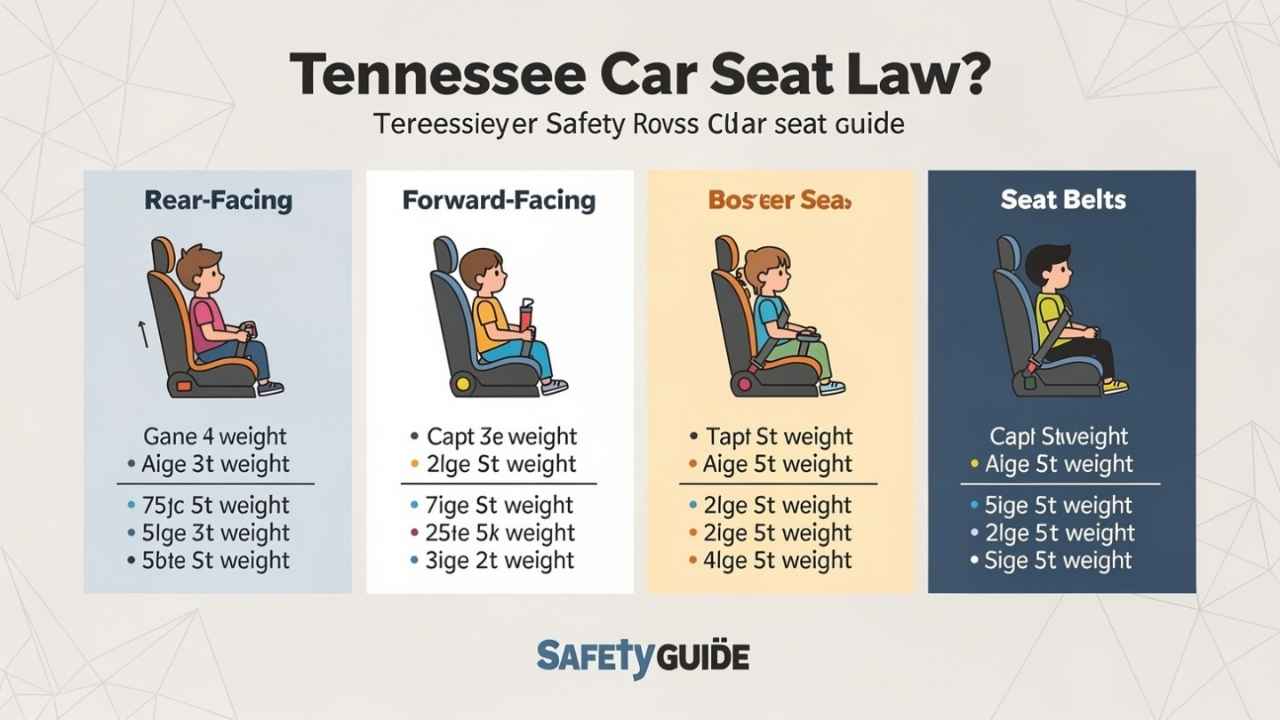
Tennessee law on car seats helps parents keep infants, toddlers, and young children safe while traveling in a vehicle. The Tennessee child passenger safety law requires age-appropriate car seats, booster seats, and seat belt use based on a child’s height, weight, and age. Parents should follow rear-facing car seat rules for babies and transition to forward-facing seats and booster seats at the right stage for maximum protection.
Understanding Tennessee car seat laws is important for family safety, avoiding fines, and reducing injury risks during road trips or daily travel. Proper installation of infant car seats, booster seat guidelines, and seat belt regulations can help protect children in accidents. Families in Tennessee should always check updated child restraint laws, safety recommendations, and traffic regulations to ensure safe and legal travel for every child passenger.
Car Seat Laws in Tennessee (2026 Guide for Parents)
Tennessee Code Annotated (T.C.A.) 55-9-602
Understanding car seat rules in Tennessee isn’t just about following the law—it’s really about making sure every ride is as safe as possible for children. Over the years, many parents only realize the importance of proper restraint after seeing how strict enforcement can be during routine checks or after minor accidents.
In Tennessee, child passenger safety laws are clearly outlined under T.C.A. 55-9-602, requiring children to use age- and size-appropriate car seats or booster seats. These rules align closely with recommendations from the National Highway Traffic Safety Administration, which strongly emphasizes correct seat selection and proper installation.
Infants (Under 1 Year or Under 20 lbs)
Infants must always ride in a rear-facing car seat placed in the back seat.
- Rear-facing position supports the baby’s head, neck, and spine
- Never place an infant in a front seat with an active airbag
- Keep rear-facing as long as the seat allows (safety experts recommend longer if possible)
From a practical point of view, most parents find rear-facing infant seats easier when they come with a detachable base for quick in-and-out use.
Toddlers (1–3 Years or Over 20 lbs)
Toddlers should transition to a forward-facing car seat with a harness, still placed in the back seat.
- Harness straps should be snug at shoulder level or slightly above
- The seat should be tightly secured with minimal movement
- Keep children in a harness longer rather than switching too early to boosters
Many parents rush this stage, but keeping a child in a harness longer significantly improves crash protection.
Preschoolers (4–8 Years or Under 4’9”)
At this stage, children should use a booster seat.
- Booster seats help position the seat belt correctly across chest and hips
- The lap belt should rest on the upper thighs not the stomach
- Always keep children in the back seat for maximum safety
In real-world terms, this is the phase where many kids “feel big enough,” but the booster is still doing an important job most parents underestimate.
Older Children (9–12 Years or 4’9” and Above)
Older children can usually transition to a standard seat belt, but proper fit is critical.
- Seat belt should lie flat across the chest and upper thighs
- Knees should bend comfortably at the seat edge
- Back seat is still strongly recommended for safety
Even at this age, height matters more than age when deciding readiness.
Teens (Under 16 Years)
Under Tennessee law, all passengers under 16 must be properly restrained.
- Seat belts are mandatory at all times
- Proper seating position reduces injury risk significantly
- Rear seat is still the safest option whenever possible
Key Legal Responsibility
Under Tennessee Code Annotated (T.C.A.) 55-9-602, the driver is responsible for ensuring that every child passenger is properly secured.
Failure to comply can result in fines and legal penalties, but more importantly, it increases the risk of serious injury in crashes.
Changes of Tennessee’s Child Safety Seat Laws Over Time
Tennessee’s child passenger safety laws have gradually become stricter over the years as crash data and safety research improved. Earlier rules mainly focused on age limits, but modern updates under Tennessee Code Annotated (T.C.A.) 55-9-602 now emphasize height, weight, and proper restraint use. Over time, the law shifted from basic compliance to a more safety-focused approach aligned with recommendations from the National Highway Traffic Safety Administration, especially encouraging longer rear-facing use and proper booster seat transitions.
- Earlier laws focused mainly on age-based requirements only
- Updates added height and weight-based seat selection rules
- Stronger emphasis on rear-facing seats for infants and toddlers
- Booster seat use extended for better seat belt positioning
- Increased enforcement and awareness campaigns over time
- Alignment with federal child passenger safety guidelines
Penalties For Not Using a Car Seat in Tennessee
Tennessee takes child passenger safety violations seriously, and penalties are designed to encourage compliance rather than just punishment. Under Tennessee Code Annotated (T.C.A.) 55-9-602, drivers can face fines and legal consequences if a child is not properly restrained according to age and size requirements.
- Traffic fines are issued for each violation
- Court costs may be added to the penalty
- Repeated violations can increase fines
- Possible points on driving record in some cases
- Law enforcement may stop vehicles for safety checks
- Driver is fully responsible for child passenger safety compliance
What to Do if Your Child Was Hurt in a Car Accident
If a child is injured in a crash, the first priority is immediate medical attention, even if injuries seem minor at first. Many injuries especially in young children may not be visible right away. After ensuring safety, it’s important to document the incident and follow legal and insurance steps carefully.
- Seek emergency medical care immediately
- Document the accident scene and vehicle damage
- Get a full medical evaluation for hidden injuries
- Contact your insurance company promptly
- Keep all medical records and bills for claims
- Consider consulting a legal professional for compensation guidance
- Follow up with doctors for delayed symptoms or complications
Children Under 1 Year of Age or 20 Pounds or Less
From what safety experts consistently emphasize and what many parents often realize only after using the seat—infants are at the highest risk during a crash, which is why Tennessee law is very strict at this stage. Under Tennessee Code Annotated (T.C.A.) 55-9-602, babies must remain in a rear-facing seat for maximum protection of the head, neck, and spine. Guidance from the National Highway Traffic Safety Administration also strongly supports keeping children rear-facing as long as possible, beyond the minimum legal requirement.
- Must use a rear-facing child safety seat
- Applies to children under 1 year or 20 lbs or less
- Seat must meet federal safety standards
- Must be installed exactly as per manufacturer instructions
- Always placed in the back seat
- Harness should be snug with no slack around shoulders
Children Ages 1 Through 3
At this stage, many parents start transitioning seats, but safety-wise, keeping children properly harnessed is far more important than rushing upgrades. In real-world situations, properly fitted harness seats have proven significantly more effective in preventing injury during sudden impacts.
- Must use a child safety seat (rear or forward-facing)
- Applies to children 1–3 years and over 20 pounds
- Must ride in the back seat
- Harness straps should sit at or above shoulders (forward-facing)
- Seat must be tightly secured with minimal movement
- Recommended to keep rear-facing as long as possible if seat allows
Children Ages 4 Through 8
This is often the stage where children want to “graduate” from car seats, but proper belt positioning is still critical. Under Tennessee Code Annotated (T.C.A.) 55-9-602, booster seats are required until the seat belt fits correctly without assistance.
- Must use a booster seat with seat belt
- Applies to ages 4–8 years
- Height requirement: under 4’9”
- Seat belt must lie across upper thighs and chest (not stomach or neck)
- Must always sit in the back seat
- Booster ensures correct seat belt geometry for safety
Children Older Than 8 Years
By this stage, children may be legally allowed to use a seat belt alone, but safety professionals still stress proper fit over age alone. Many parents only notice the importance of this when a seat belt rides too high on the stomach or too low on the neck, which can increase injury risk.
- Must use a standard seat belt system
- Applies to children 8 years and older
- Height should generally be 4’9” or taller
- Seat belt must fit correctly across chest and hips
- Back seat is strongly recommended until age 12
- If fit is improper, a booster seat is still required
Expert Safety Insight (Important Reality Check)
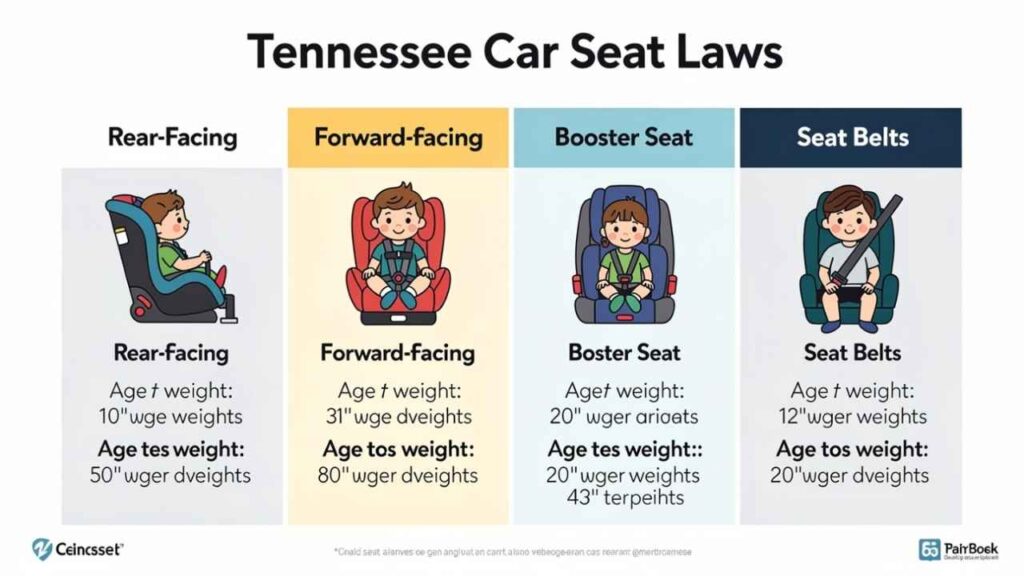
In practice, the safest setups always go beyond minimum legal requirements. Both parents and safety instructors often agree that proper installation matters just as much as the seat itself. The rules under Tennessee Code Annotated (T.C.A.) 55-9-602 combined with recommendations from the National Highway Traffic Safety Administration are designed to reduce preventable injuries, especially in side-impact collisions where improper restraint is a major risk factor.
Tennessee Law on Car Seats for Adults
In Tennessee, adults are not required to use car seats or booster seats, but they must wear a seat belt in all seating positions under Tennessee Code Annotated (T.C.A.) 55-9-603. In real-world road safety discussions, this is often where confusion happens some people assume booster rules extend into adulthood, but legally, once a person meets standard seat belt fit, no child restraint is required.
From a safety perspective, organizations like the National Highway Traffic Safety Administration consistently highlight that adults are safest when the seat belt fits correctly across the chest and hips. In practice, most adults simply adjust seat position and belt height rather than needing any special device, and enforcement mainly focuses on proper seat belt usage rather than seating type.
Backless Booster Seat Requirements in Tennessee
Backless booster seats in Tennessee are required for children who have outgrown forward-facing seats but are still too small for a proper seat belt fit. Under Tennessee Code Annotated (T.C.A.) 55-9-602, this generally applies to children who are under 4 feet 9 inches tall, usually between ages 4–8.
From a practical standpoint, many parents only realize the importance of a backless booster when the seat belt rides too high on the stomach or neck. Safety experts, including the Insurance Institute for Highway Safety, consistently stress that a booster is not about age it’s about proper belt positioning to reduce injury risk during sudden stops or collisions.
When Can a Child Sit in the Front Seat in Tennessee
Tennessee law does not set a strict legal age for front-seat use, but safety guidelines strongly recommend that children remain in the back seat until at least 12 years old under Tennessee Code Annotated (T.C.A.) 55-9-602. This is because airbags and front-impact forces can be dangerous for smaller bodies.
In everyday driving situations, safety professionals often observe that parents move children forward too early once they meet basic seat belt requirements. However, organizations like the National Highway Traffic Safety Administration continue to advise that the back seat is significantly safer, especially for children under 13, due to reduced exposure to direct impact and airbag deployment risks.
Booster Seat Weight Requirements in Tennessee
In Tennessee, booster seat use is not based on weight alone—it is mainly determined by height and proper seat belt fit under Tennessee Code Annotated (T.C.A.) 55-9-602. In most real-world situations, children typically need a booster between 40–80 pounds, but the key factor is whether the seat belt sits correctly across the body without sliding onto the stomach or neck.
From a practical safety standpoint, many parents only realize the importance of boosters when they notice the seat belt doesn’t “sit right” on their child. Organizations like the National Highway Traffic Safety Administration emphasize that a booster is necessary until a child is tall enough usually around 4’9” for the seat belt to naturally fit across the chest and upper thighs.
Belt-Positioning Booster Seat
A belt-positioning booster seat is designed to help a child transition from a harness system to a standard seat belt by correctly aligning the belt across the strongest parts of the body. Under Tennessee Code Annotated (T.C.A.) 55-9-602, children must use this type of booster until they are tall enough for the seat belt to fit properly on its own.
In real-life use, parents often find that booster seats are more about comfort and safety alignment than age. Safety research from the Insurance Institute for Highway Safety shows that correct belt positioning significantly reduces abdominal and spinal injuries in crashes, which is why boosters remain essential even for older, bigger-looking kids.
Rear-Facing Car Seat Laws in Tennessee
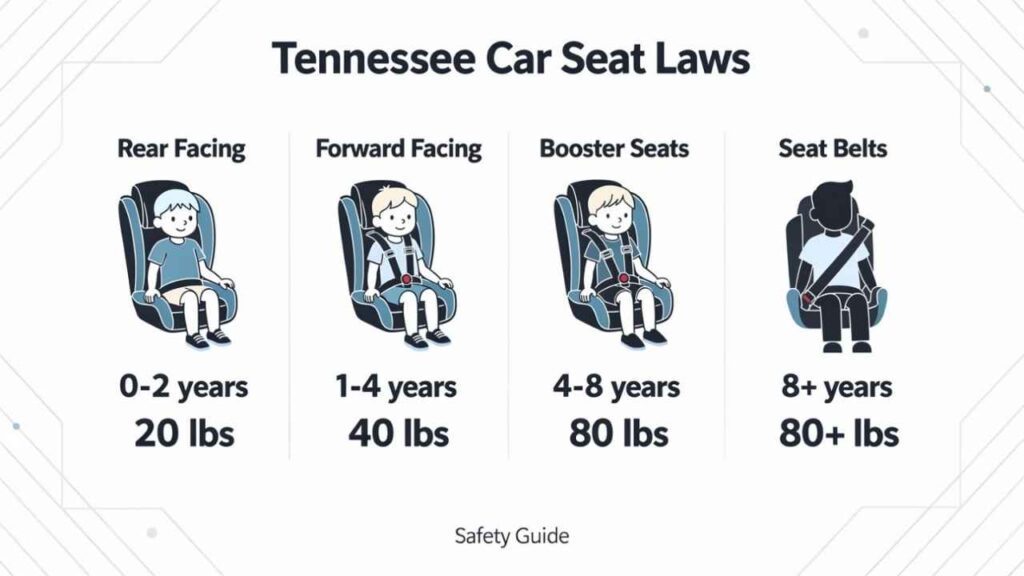
Tennessee law requires infants to ride in rear-facing car seats, and safety experts strongly recommend extending this phase as long as possible. According to Tennessee Code Annotated (T.C.A.) 55-9-602, children under 1 year or 20 pounds must remain rear-facing in a properly installed seat.
From experience shared by many child passenger safety technicians, rear-facing seats provide the best protection in real crash scenarios because they distribute impact forces evenly across the back. The National Highway Traffic Safety Administration also recommends keeping children rear-facing beyond the minimum requirement whenever the seat allows, as it greatly reduces the risk of head and neck injuries in sudden stops or collisions.
👉🏻Discover More About Unique Laws[ Car Seat Laws for Kentucky ]
Frequently Asked Questions
Are car seats required in Tennessee?
Yes, car seats are required in Tennessee for all children who do not yet fit properly in a standard seat belt under Tennessee Code Annotated (T.C.A.) 55-9-602. The law requires age-, height-, and weight-appropriate restraints such as rear-facing seats, forward-facing seats, and booster seats.
In simple terms, a child must stay in a car seat or booster until the seat belt fits correctly across the chest and lap. Safety authorities like the National Highway Traffic Safety Administration confirm that proper car seat use greatly reduces injury risk in crashes.
Can my 7-year-old be in the front seat?
In Tennessee, there is no specific legal age that bans a 7-year-old from sitting in the front seat, but it is strongly discouraged under Tennessee Code Annotated (T.C.A.) 55-9-602. Safety guidance recommends that children remain in the back seat until at least 13 years old.
From a safety perspective, the front seat exposes a child to airbag force and higher crash impact. The National Highway Traffic Safety Administration consistently advises that the back seat is the safest place for young passengers.
What is the height and weight requirement for a booster seat in Tennessee?
Tennessee law does not set a strict weight limit, but children typically need a booster seat when they are under 4 feet 9 inches tall under Tennessee Code Annotated (T.C.A.) 55-9-602. This often includes children roughly between 40–80 pounds, depending on body size.
The key safety rule is proper seat belt fit not age or weight alone. According to the Insurance Institute for Highway Safety, a booster is needed if the lap belt sits on the stomach or the shoulder belt touches the neck.
Do I have to wear a seatbelt in the backseat in Tennessee?
Yes, seat belts are required for all passengers in Tennessee, including those sitting in the back seat, under Tennessee Code Annotated (T.C.A.) 55-9-603. Every person in the vehicle must be properly restrained.
Safety research from the National Highway Traffic Safety Administration shows that seat belts significantly reduce the risk of serious injury or death, even for backseat passengers, making it a mandatory and essential safety rule.
Conclusion
Following the Tennessee law on car seats is essential for child passenger safety and safe family travel. Using the correct rear-facing car seat, forward-facing seat, booster seat, and seat belt helps protect infants, toddlers, and young children during every ride. Parents should always check car seat installation guidelines, weight limits, height requirements, and updated Tennessee child restraint laws for better road safety.
Proper car seat use in Tennessee can reduce injuries and keep children secure in cars, SUVs, and other vehicles. Understanding booster seat laws, child safety regulations, and traffic safety rules helps families travel legally and confidently. By following Tennessee car seat regulations and child passenger laws, parents can ensure comfort, protection, and safety for every child on the road.

Michael is a car seat specialist with 4 years of experience in reviewing, testing, and guiding people on the best car seat choices. He creates clear, reliable content to help users make safe and confident decisions.