
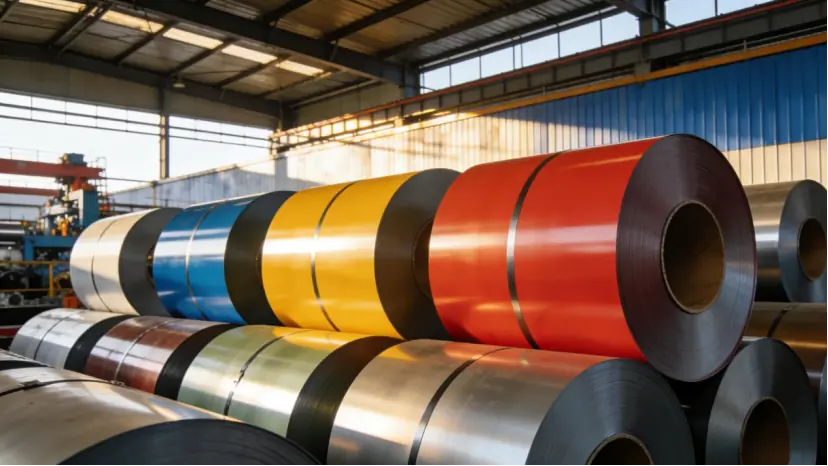
In the context of current-day shape and design of business organization construction, selection of material not only determines simplicity of beauty but also durability. In the vast collection of available metallic materials, natural-coated metal, or what is otherwise referred to as prepainted metal coil,l forms an integral part of sustainable and highly modern performance envelope engineering. This advanced system, which is produced via non-preventive coil coating methods, consists of the strength of the metallic substrate combined with the environmental resistance of high-quality resin systems. Considering the changing demands in construction due to the Internet-0 demand and climatic resilience, an understanding of the delicate chemistry of coatings is indispensable.
1. Basic Construction and Manufacturing Processes of Organically Coated Steel
Stainless steel manufacturers‘ coils go through a continuous automated roll-coating process, which guarantees the integrity of chemical bonding and constant dry film thickness (DFT). Contrary to traditional coating, place-based coating or scenario-based coating, non-preventive coil coating carries out floor cleaning, chemical conversion,
Mostly, the primer and curing of the topcoat are done together in one continuous operation without any disturbance at all.
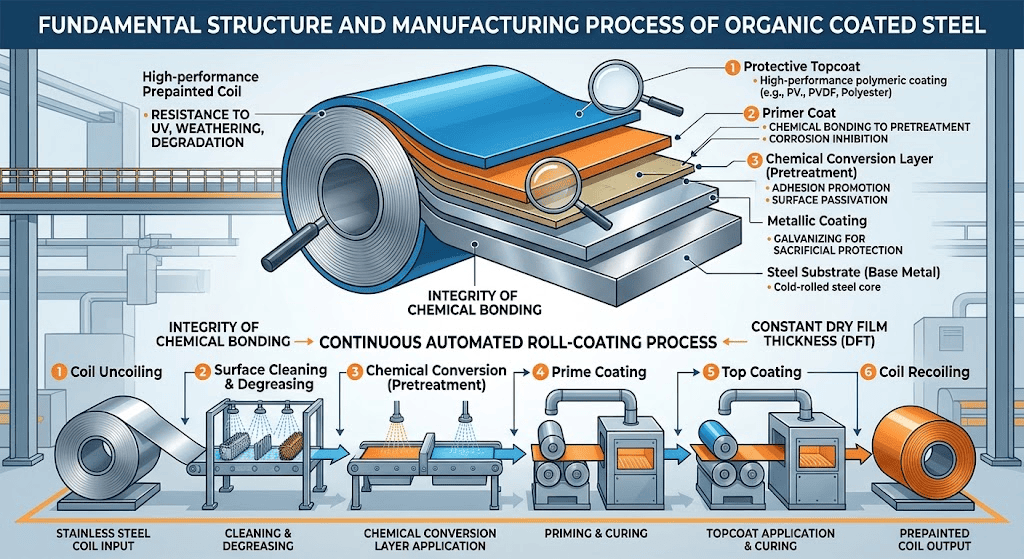
Bypass-segment in the case of high performance prepainted coil consists of various protective layers that help in preventing delamination, mechanical micro-cracks, and the influence ofthe environment:
- Modern procurement agencies,s in cooperation with Construction Management Companies, should adhere to worldwide tolerances, in addition to ASTM A755, EN 10169 and ISO 12944.
2. Resin Chemistry and Performance Properties
Performance characteristics of pre-painted steel are completely based on the choice of resin chemistry used for making the top coat. Selection of suitable chemistry is based on solar reflectivity, flexibility, resistance to chemicals, and performance of materials.
Polyester (PE)
Polyester is a synthetic plastic that is used for classical roofing, interiors of organization walls, and cladding materials. The presence of an ester group in polyester provides elasticity, economical hardness, and a colorful appearance of the material. However, polyester is easily subjected to photo-oxidation reactions due to ultraviolet radiation.
Silicone Modified Polyester (SMP)
The SMP coating system consists of silicones which are combined with polyester resin (20%-30% of silicone-containing material in the cloth). Polyurethane (PU) & Polyurethanic Hydroxylated Polymer (PUR/PA)
Aliphatic polyisocyanate-based polyurethane coating provides excellent resistance to scratches and moisture penetration. There are some other specific coatings, like PA polyurethane coating,g providing texture coating along with wear resistance.
Technical Information on UV & Corrosion Testing
Performance criteria are tested under accelerated weather conditions. Comparison with regard to UV resistance is done with ISO 4892 / ASTM G154 (QUV test), while general corrosion resistance testing is done through salt spray testing (ASTM B117 / ISO 9227) up to 500 to 2,000+ hours.
3. Atmospheric Corrosivity Categories and Selection Matrix
In designing building envelopes for nearby projects, atmospheric severity influences the thickness of substrates and composition of top coats. Working with an experienced Construction Company in Oman provides invaluable local information to civil engineers regarding exposure to intense solar radiation, extreme temperature differences, and salty air within the coastal desert regions.
The table below provides coating system recommendations based on ISO 12944 atmospheric corrosivity categories:
| Corrosion Class (ISO 12944) | Environmental Condition | Metal Coating of the Substrate | Paint Chemistry | Estimated Life Time |
| C1 / C2 (Low) | Heated Indoor Houses and Dry Rural Outdoors | HDG (Z100 – Z140) | Standard Polyester (15–20 µm) | 15–20 years |
| C3 (Medium) | Urban Airs and Mild Corporate Environment | HDG / Galvalume (Z180 / AZ100) | SMP or Polyurethane (20–25 µm) | 20–25 years |
| C4 (High) | Industrial Environment and Inland Coastal Areas | Galvalume / Aluzinc (AZ150) | High performance SMP or PVDF (25–35 µm) | 25–30 years |
| C5 (Very High) | Marine Areas and Heavy Commercial/Industrial Chemical Environments | Galvalume / SuperDyma (AZ180+) | PVDF / PUR-PA (35–50 µm) | 30–50 years |
4. Contemporary Architectural and Manufacturing Uses
The prepainted metal coils include the main unprocessed material for an amazing range of contemporary construction materials, converting crude mill products to structural and design elements:
- Standing Seam Roofing Systems: Concealed fastener system that may be used on low-sloped roofs requiring hydrostatic strength and high movement capacity.
- Insulated Metal Panels (IMPs): Composite panels manufactured in pre-fabricated form having two prepainted metallic panels that are bonded to a PIR or mineral wool insulation substrate.
- Architectural Cassettes and Wall Cladding: Rainscreen system modules which are precision engineered, having thick prepainted metal sheets providing a flat appearance.
- Cold Formed Interior Partition: Pre-finished interior metal studs and linear ceiling systems fabricated from antimicrobial or antistatic natural finishes.
5. Life-Cycle Cost Assessment & Quantities Guidelines
Although costs of fabric for sophisticated herb finishes (together with PVDF or polyurethanes) exceed regular polyester by way of 20% to forty-five percent, life-cycle value evaluation keeps proving itself to be economically beneficial in the lengthy term. Fewer paint applications, higher recoat cycles, and economy in terms of energy and money gained by utilizing high Solar Reflectance Index (SRI)
cool roof” pigment paints compensate for the preliminary cost outlay.
Estimation Model for Material Take-off and Costs
Below is an estimation model providing indicative fabric and work costs per rectangular meter for enterprise project planning in several prepainted coil products:
| Profile | Substrate Specification | Top Coat Thickness & Chemistry | Base Steel Material Price per Sq. m | Fabrication & Installation per Sq. m | Total Estimated Installed Cost per Sq. m |
| Standard Industrial | HDG Z180 (0.50 mm) | 20 µm Regular Polyester | $8.50 – $10.50 | $12.00 – $15.00 | $20.50 – $25.50 |
| Enhanced Commercial | Galvalume AZ150 (0.60 mm) | 25 µm Siliconized Polyester (SMP) | $11.50 – $14.00 | $15.00 – $18.50 | $26.50 – $32.50 |
| Architectural Premium | Galvalume AZ150 (0.70 mm) | 30 µm PVDF (70/30) Fluoropolymer | $16.00 – $20.00 | $20.00 – $26.00 | $36.00 – $46.00 |
| Severe Marine / Chemical | Aluzinc AZ180 (0.80 mm) | 40 µm Polyurethane-Polyamide (PUR-PA) | $21.00 – $26.00 | $24.00 – $32.00 | $45.00 – $58.00 |
6. Significant Benefits of Advanced Organically Coated Steel
Heat Resistance Properties: With the use of IR-reflecting pigments (inorganic), prepainted metal panels can achieve higher SRI ratings, which can help reduce the urban heat island effect and air conditioning loads on buildings.
- Forming and Ductility Properties: With its superior resin bonding properties, prepainted metal panels can be bent, drawn, and rolled extensively without causing microcracking or glazing.
- Environmental Sustainability: The modern solventless coil paint manufacturing process uses closed thermal oxidation technology that removes all VOCs to ensure that the products are 100% recyclable.
- Synergy of Corrosion Prevention: The two-layer protection system of passive barrier properties of natural polymers combined with sacrificial qualities of zinc-aluminum alloys provides an exponential increase in service life compared to either alone.
7. Comparative Material Analysis: Coated Carbon Against Other Materials
| Decision-Making Factor | Comparative Relationship | Context & Application Insight |
| Structural Yield Strength | Carbon Steel Coils > Stainless Alloys | Carbon steel provides higher baseline structural capacity; stainless alloys are chosen primarily for severe chemical or corrosion resistance. |
| Atmospheric Corrosion Resistance | Stainless / PVDF Galvalume > Standard Polyester | Advanced coatings (PVDF) and stainless steel offer superior longevity in harsh industrial processing plants or coastal zones. |
| Solar Reflectivity Choices | Prepainted IR Coils > Uncoated Metal Surfaces | Infrared-reflective coils actively reduce heat absorption and thermal load compared to standard bare metal surfaces. |
| Initial Capital Investment | Prepainted HDG < PVDF Galvalume < Stainless Steel | Initial costs scale up progressively from standard prepainted HDG up to premium corrosion-resistant stainless steel. |
Conclusion
Coated steel coils have become one of the essential fabric solutions that combine structural functions with better chemical protection. Through the choice of the most perfect combination of steel substrate, pretreatment chemistry, and polymer topcoat materials, professionals will be able to create construction envelopes capable of coping as well as possible under conditions of the harshest natural impact. Taking into account the fact that global building codes focus on thermal performance, long-term durability, and material recycling, the continuous development of coil coating technology will remain relevant for sustainable design.
Frequently Asked Questions (FAQs)
What is the average lifetime of prepainted metal coil roofs?
Depending on the atmospheric conditions, the amount of substrate zinc/aluminum coating, and resin chemistry (including SMP or PVDF), modern prepainted metal roofs have an expected service life from 20 up to more than 50 years with minimal maintenance.
How is coil painting different from submit painting or area spraying?
It may be considered a non-preventive coating since it is an advanced commercial process whereby the flat steel strip is cleaned, pre-treated, primed, painted, and oven-cured before processing. This coating process helps in ensuring film thickness consistency and improved adhesion and no VOC emissions in comparison with case spraying.
Can pre-painted metal coils be bent or roll-formed without destroying the coating?
Yes, organic topcoats are made up of flexible polymer chains (moderate T-bend flexibility index) such that the coated sheet can bend sharply and can go through deep drawing and roll-forming at a very high speed without splitting, stripping,g or losing adhesion.
Cool Roof Prepainted Steel Coil?
This is the one that makes use of topcoats containing unique inorganic color pigments (CICPs). The CICPs reflect the infrared rays of the sun while still keeping their visible color.
