
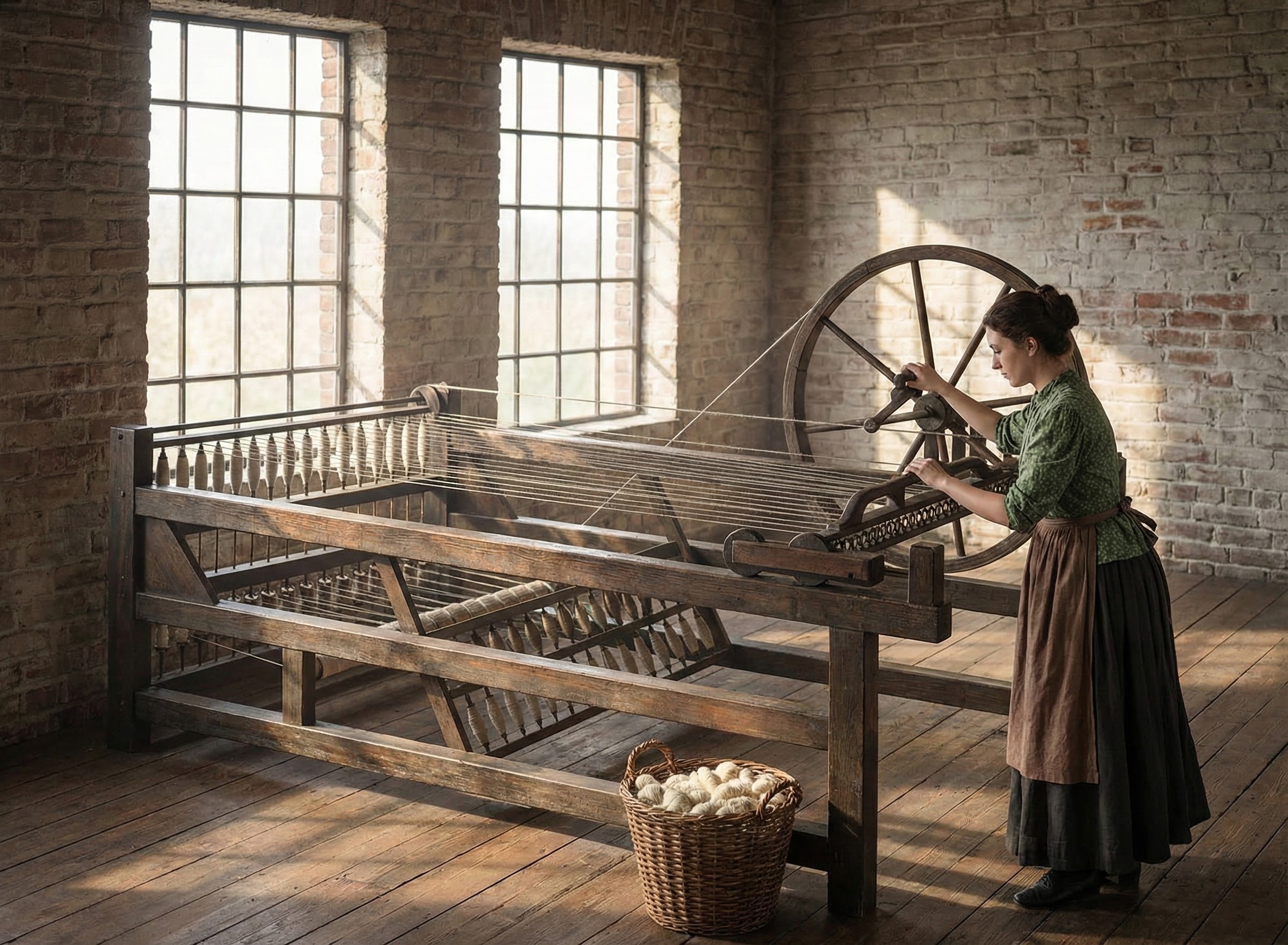
For centuries, the spinning wheel defined how fiber became yarn. A single strand, twisted by hand or foot-powered wheel, could take hours to produce what a modern factory now finishes in seconds. Understanding how spinning technology evolved helps explain why today’s textile industry looks nothing like it did even fifty years ago.
The Age of Mechanical Spinning
The Industrial Revolution changed everything. Machines like the spinning jenny and the water frame allowed a single operator to manage dozens of spindles at once. Ring spinning, introduced in the 19th century, became the industry standard for generations because it produced strong, consistent yarn suitable for nearly any fabric type.
Why Ring Spinning Lasted So Long
Ring spinning wasn’t perfect, but it was reliable. It worked with almost every fiber type, from cotton to wool blends, and mills across the world built their entire production processes around it. Its main drawback was speed — the mechanical process of twisting and winding yarn onto a bobbin limited how fast a machine could run without sacrificing quality.
The Shift Toward Open-End and Rotor Spinning
By the mid-20th century, manufacturers wanted faster methods that didn’t compromise yarn integrity. Open-end spinning, often called rotor spinning, emerged as an answer. It skipped several mechanical steps used in ring spinning, allowing yarn to be produced at higher speeds with less handling.
Rotor spinning worked well for coarser yarns used in denim, workwear, and industrial textiles. However, it wasn’t ideal for finer counts or fabrics requiring a smoother hand feel, which kept ring spinning relevant in premium apparel production.
Enter Air-Based Spinning Methods
The next major leap came when engineers began experimenting with airflow instead of mechanical rotation to twist fibers. This approach reduced moving parts, increased speed dramatically, and opened the door to yarn structures that older methods couldn’t easily replicate.
How Airflow Changed the Equation
Instead of relying on a spinning ring or rotor, air-based systems use controlled jets of compressed air to wrap and bind fibers together. This method significantly increases production speed while reducing certain types of mechanical wear that traditional systems experience over time.
Mills that adopted air-jet spinning found that yarn could be produced with fewer hairy fibers on the surface, which improved fabric smoothness and reduced pilling in finished garments. This made the technology particularly attractive for producing lightweight knitwear and technical fabrics.
Comparing Generations of Spinning Technology
| Era | Method | Typical Use |
| Pre-1800s | Hand spinning | Small-scale, artisanal |
| 1800s–1900s | Ring spinning | General-purpose yarn |
| Mid-1900s | Rotor/open-end | Coarse, industrial yarns |
| Late 1900s–present | Air-jet and vortex spinning | High-speed, smooth-surface yarns |
Each generation solved a specific limitation of the one before it, whether that limitation was speed, yarn quality, or fiber compatibility.
Modern Applications in the Industry Today
Today’s textile manufacturers often run multiple spinning systems side by side, choosing the right one based on the end product. A denim producer might still rely on rotor spinning for its ruggedness, while a company producing performance sportswear may lean toward air-based methods for their speed and smoothness.
Facilities upgrading their production lines sometimes look at combining older ring-spinning frames with newer, faster equipment to balance output with product versatility. For teams researching updated equipment options, reviewing specifications on a modern Air jet spinning machine can offer useful context on how airflow-driven systems are built and configured compared to legacy machinery.
Training and Workforce Adaptation
One overlooked aspect of this technological shift is workforce training. Operators who spent years managing ring-spinning frames often need retraining to work confidently with air-based systems, since troubleshooting airflow issues requires a different technical understanding than mechanical faults.
Many manufacturers now build cross-training programs so their teams understand multiple spinning methods. This flexibility helps facilities respond quickly when demand shifts between different yarn types.
What This Means for the Future
Spinning technology hasn’t reached a final form — it continues to evolve as manufacturers push for faster, cleaner, and more sustainable production. Airflow-based systems represent just one chapter in a much longer story that stretches back to the earliest hand-spun threads.
As automation and smart manufacturing continue to influence textile production, the next generation of spinning equipment will likely integrate more sensors, predictive maintenance features, and energy-efficient designs. But the underlying goal remains unchanged: converting raw fiber into usable yarn as efficiently and reliably as possible.
Conclusion
The path from spinning wheels to airflow-driven machines reflects the textile industry’s constant pursuit of speed, consistency, and quality. Each innovation solved real production challenges of its time, and today’s manufacturers benefit from having a range of proven technologies to choose from. Understanding this evolution isn’t just a history lesson — it helps buyers and production managers make smarter decisions about which spinning method actually fits their operational needs.
