
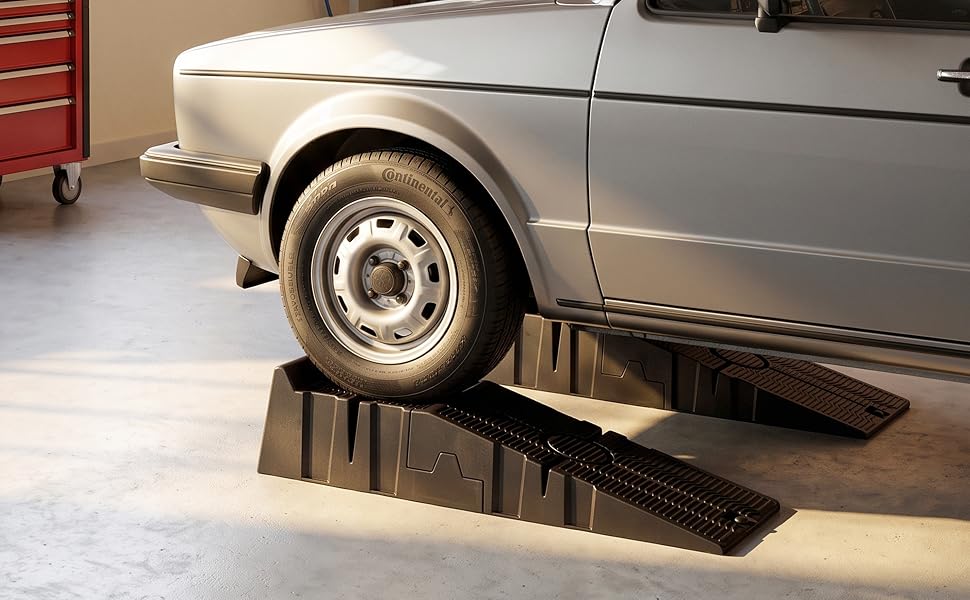
Performing basic vehicle maintenance at home can save time and reduce the need for frequent workshop visits. Tasks such as changing engine oil, inspecting the underside of a vehicle, and checking certain components often require additional ground clearance. A reliable set of car ramps can make these jobs more convenient by raising the vehicle without requiring a traditional hydraulic lift.
The Ironton Poly Car Ramp Set is a two-piece automotive accessory designed to help raise compatible cars, trucks, SUVs, and vans. Made from high-impact poly material, these ramps feature a non-skid tread pattern and rubber feet intended to improve stability during use.
With a stated capacity of 6,000 pounds per ramp and 12,000 pounds per pair, the set is designed for a range of vehicle sizes. Its lightweight construction also makes it easier to move and store than many traditional steel alternatives.
For drivers who enjoy handling routine maintenance in their own garages, understanding the ramp’s construction, capacity, benefits, and safety requirements can help determine whether it is a suitable choice.
A Practical Alternative to Lifting Every Vehicle With a Jack
A floor jack is a common tool for raising vehicles, but it is not always the most convenient option for every maintenance task. Positioning a jack correctly and lifting the vehicle can take additional effort, especially for people who perform basic maintenance regularly.
Car ramps offer a different approach. Instead of lifting the vehicle from underneath, the driver carefully moves the front or rear tires onto the ramps. Once the tires reach the raised platforms, the vehicle remains supported at an elevated position.
This arrangement can provide useful access underneath the vehicle for certain jobs, including oil changes and visual inspections.
The Ironton Poly Car Ramp Set is designed for this type of work. Its two-piece configuration provides one ramp for each tire on the selected axle, allowing both sides of the vehicle to rise together.
However, ramps are not a replacement for every type of lifting equipment. Since the tires remain on the ramps, they are not suitable for jobs that require removing those wheels, such as tire rotations or many brake repairs.
High-Impact Poly Construction for Regular Garage Use
One of the main features of the Ironton ramps is their high-impact poly construction. This material is designed to provide strength while keeping the equipment relatively lightweight.
Traditional steel ramps can be durable, but they may be heavier and can develop corrosion if their protective finish becomes damaged. Poly construction offers an alternative that does not rust in the same way as ordinary steel.
The Ironton ramps use a structured internal design intended to support the advertised load capacity. Their construction is aimed at providing a practical balance between strength, portability, and everyday garage use.
The pair weighs approximately 20.6 pounds, making it easier to move the ramps between storage and the working area.
Although the material is designed for demanding use, it still requires regular inspection. Cracks, deformation, damaged edges, or other visible defects can affect the equipment’s reliability. Any ramp showing signs of structural damage should be removed from service.
Understanding the 12,000-Pound Capacity
Load capacity is one of the most important specifications when selecting vehicle ramps. The Ironton set is rated at 6,000 pounds per ramp, giving the pair a combined stated capacity of 12,000 pounds.
It is important to understand how these numbers work.
Each ramp supports one tire, while the pair is used together to support one axle. The 12,000-pound figure should not be interpreted as permission to place any vehicle weighing up to that amount on the ramps without checking its axle load and the manufacturer’s instructions.
Vehicle weight is distributed differently between the front and rear axles. The engine, passengers, cargo, and vehicle design all affect how much weight each axle carries.
Before using the ramps, check the vehicle’s specifications and ensure the axle load remains within the applicable rated capacity. Also confirm that the tire width and vehicle configuration are compatible with the ramp design.
Never exceed the manufacturer’s stated limits, and do not use the ramps for equipment or loads they were not designed to support.
Non-Skid Tread Helps Maintain Tire Grip
A vehicle needs to move onto the ramps in a controlled manner. If the tire loses traction during this process, climbing onto the raised platform may become difficult and potentially dangerous.
The Ironton ramps feature a non-skid tread pattern designed to improve tire grip. The textured surface provides contact between the tire and the ramp as the vehicle moves upward.
This design can help reduce unwanted tire movement during loading. It also provides a more secure surface once the vehicle reaches the raised section.
Drivers should still approach the ramps slowly and keep the tires aligned with the center of each platform. The tread pattern is an additional traction feature, not a guarantee that slipping cannot occur.
Damaged, wet, oily, or contaminated surfaces may affect traction. Clean the ramps when necessary and inspect the tread before each use.
Rubber Feet for Better Ground Stability
Tire traction is only one part of safe ramp operation. The ramps themselves must also remain properly positioned on the ground.
The Ironton set includes rubber feet on the underside of each ramp. These are designed to improve contact with the supporting surface and help reduce movement as the vehicle climbs.
This feature is particularly useful when the ramps are placed on a suitable garage floor or driveway. A stable base helps keep the ramp aligned with the tire during loading.
However, rubber feet cannot make an unsuitable surface safe. Always use the ramps on firm, level ground. Avoid soft soil, loose gravel, uneven pavement, or surfaces that may shift under the vehicle’s weight.
Before driving onto the ramps, check that both units are positioned securely and that nothing is trapped underneath them.
Dimensions and Vehicle Compatibility
The Ironton Poly Car Ramp Set measures approximately 35.5 inches long, 12 inches wide, and 8.5 inches high.
These dimensions are designed to accommodate a variety of compatible vehicle tires. The 12-inch width provides a reasonably broad driving surface, while the length creates a gradual approach compared with shorter, steeper ramps.
The listed wheel lift height is approximately 6.7 inches. This is the useful elevation provided to the vehicle’s tires, while the overall ramp height is 8.5 inches.
The set is intended for use with various cars, trucks, SUVs, and vans. However, vehicle category alone does not determine compatibility.
Drivers should consider:
- Tire width and overall tire dimensions.
- Vehicle weight and axle load.
- Front bumper and underbody clearance.
- The vehicle’s approach angle.
- The manufacturer’s recommended lifting and support points.
Low-sitting sports cars and vehicles with front spoilers may have difficulty climbing certain ramps. The gradual design may help with some vehicles, but it does not guarantee clearance for every low-profile model.
Checking the vehicle’s dimensions before purchasing can prevent unnecessary fit problems.
Lightweight Design Makes Storage Easier
Garage equipment often needs to be moved around depending on the maintenance task. Heavy ramps can become inconvenient when they need to be carried from storage, positioned under a vehicle, and put away afterward.
The Ironton pair weighs approximately 20.6 pounds. This makes the set relatively manageable for many home mechanics.
The two-piece design also allows the ramps to be stored separately when they are not being used. They can be placed in a garage storage area or another suitable location without requiring a permanent installation.
Their lightweight construction does not mean they should be handled carelessly. Avoid dropping them from significant heights, dragging them over sharp surfaces, or storing heavy objects on top of them.
Keeping the ramps clean and protected from unnecessary damage can help maintain their condition over time.
What Maintenance Jobs Can You Perform With Car Ramps?
Car ramps are especially useful for maintenance tasks that require access underneath a vehicle while its tires remain supported.
The Ironton set may help with several routine jobs when the vehicle and task are compatible.
Engine oil changes: Raising the front of a vehicle may provide more convenient access to the oil drain area on models where the drain plug is located underneath.
Undercarriage inspections: The additional clearance can make it easier to visually inspect certain components, check for leaks, and look for obvious damage.
Exhaust system checks: Ramps may provide access for visual inspections of accessible exhaust components, provided the vehicle is safely supported and cooled.
General maintenance: Some basic checks and cleaning tasks may become easier when the vehicle is positioned at a suitable height.
However, ramps are not appropriate for every repair. Because the tires remain on the platforms, they cannot provide the same access as a jack and jack stands when removing wheels or working on components that require them to be off the ground.
How to Position and Use the Ramps Safely
Proper setup is essential whenever a vehicle is driven onto ramps. Even strong equipment can become dangerous if it is placed incorrectly or used on an unstable surface.
Prepare the Working Area
Choose a firm, level surface with enough space around the vehicle. A clean concrete garage floor is generally preferable to soft or uneven ground.
Remove loose objects, tools, and debris from the area. Make sure the vehicle can approach the ramps in a straight line.
Position Both Ramps
Place one ramp directly in front of each tire on the axle you intend to raise. Align them carefully so the tires will travel toward the center of the platforms.
Check that the rubber feet are making proper contact with the ground. Both ramps should be positioned evenly.
Drive Up Slowly
Have a helper guide you if possible. Move the vehicle forward slowly and maintain straight tire alignment.
Avoid sudden acceleration or aggressive braking while climbing. Stop when the tires reach the intended position at the top of the ramps.
Secure the Vehicle
Once the vehicle is correctly positioned, apply the parking brake and select Park for an automatic transmission or an appropriate gear for a manual transmission.
Use suitable wheel chocks on the wheels that remain on the ground. Confirm that the vehicle is stable before beginning any work.
Follow Proper Support Procedures
Never place yourself underneath a vehicle unless it is securely supported according to the vehicle and equipment manufacturers’ instructions.
If the maintenance task requires additional support, use properly rated equipment at the approved support points. Never rely on an improvised arrangement or exceed the ramps’ intended use.
Important Safety Considerations Before Working Underneath a Vehicle
Car ramps can provide useful access, but vehicle maintenance always involves risks. A mistake during loading or positioning can cause the vehicle to move unexpectedly.
Keep these precautions in mind:
- Inspect both ramps before every use.
- Never use cracked, damaged, or deformed ramps.
- Confirm that the vehicle’s axle load is within the rated capacity.
- Check tire width and alignment before driving onto the platforms.
- Use a level, hard, and stable surface.
- Keep people away from the vehicle while it is being driven onto the ramps.
- Never exceed the manufacturer’s load limits.
- Chock the wheels that remain on the ground.
- Never work underneath a vehicle that is supported only by equipment used outside its instructions.
- Do not use ramps for repairs that require the supported wheels to be removed.
Following these steps can reduce avoidable risks and make routine maintenance more manageable.
Poly Ramps Compared With Traditional Steel Ramps
Both poly and steel ramps can serve the same general purpose, but their materials create different ownership experiences.
Steel ramps are known for their rigid construction and may be suitable for demanding workshop environments. However, they can be heavy, and damaged coatings may allow corrosion to develop.
Poly ramps are generally lighter and do not rust like ordinary steel. They can also be easier to move and store, making them attractive for home garages.
The Ironton set focuses on these practical benefits through its high-impact poly body, textured tread, and rubber feet.
Material alone should never determine which ramp is safer. Buyers should compare rated capacity, dimensions, construction quality, condition, and manufacturer instructions before making a decision.
Who Should Consider the Ironton Poly Car Ramp Set?
These ramps may be useful for several types of vehicle owners.
Home mechanics who perform regular oil changes and visual inspections may appreciate having a simple way to raise a compatible vehicle. Drivers who want to reduce their dependence on workshop equipment for basic tasks may also find the design convenient.
Owners of compatible SUVs, trucks, vans, and passenger cars may benefit from the stated capacity, provided the actual axle load and tire dimensions fall within the manufacturer’s requirements.
Small garages may also consider the set for suitable maintenance work. Its relatively light weight makes it easier to move between jobs compared with some heavier alternatives.
However, professional workshops that regularly perform wheel removal, suspension repairs, or other complex jobs may need additional lifting equipment.
Final Verdict on the Ironton Poly Car Ramp Set
The Ironton Poly Car Ramp Set offers a practical lifting solution for drivers and home mechanics who need additional vehicle clearance for certain maintenance tasks. Its high-impact poly construction, 6,000-pound rating per ramp, 12,000-pound capacity per pair, non-skid tread, and rubber feet provide several useful features.
The 35.5-inch length and 12-inch width offer a broad driving surface, while the approximately 6.7-inch wheel lift height provides additional access underneath compatible vehicles. Its 20.6-pound pair weight also makes storage and handling more convenient.
There are important limitations to remember. Buyers must check axle weight, tire width, ground clearance, and approach angle before use. The ramps also cannot replace a floor jack and jack stands for jobs that require wheel removal or different lifting positions.
For people who regularly perform oil changes and basic inspections at home, the Ironton ramps are worth considering when their specifications match the vehicle. Careful positioning, proper wheel chocking, and following all safety instructions are essential for dependable use.
