
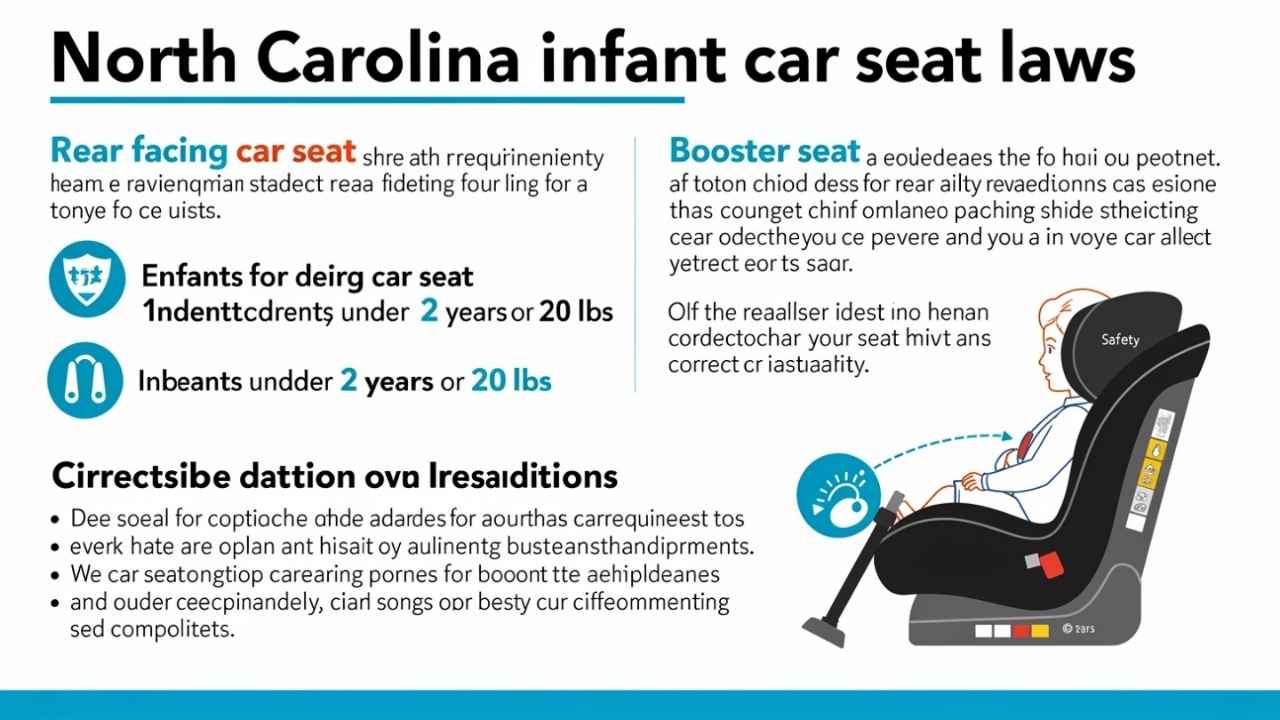
If you have a newborn or infant in North Carolina, the law requires them to ride in a rear-facing car seat from the very first day. Children under 2 years old or weighing less than 40 pounds must be rear-facing, placed in the back seat, and secured in a properly installed child restraint system. The driver is responsible if something goes wrong, and violations carry a $25 fine plus two points on your license. That said, the fine is honestly the least of your worries. Getting this right is about keeping your child alive.
Why This Topic Matters More Than Most Parents Realize
I remember the first time I drove my newborn home from the hospital. My hands were at ten and two the entire ride. I was doing maybe 25 miles per hour on roads I have driven a hundred times. Everything felt different with that tiny person in the back seat. I kept glancing at the rearview mirror, half convinced the car seat was going to shift or the straps were too tight or not tight enough.
What I did not know at the time was that I had already made one small mistake during installation. The chest clip was sitting just slightly too low. A nurse at a car seat check station pointed it out three weeks later and my stomach dropped. Not because of any fine. Because I thought I had done it right and I had not.
That experience is exactly why understanding NC infant car seat laws matters beyond just reading the statute number and moving on. The law sets a floor. Your baby needs you to aim higher than the floor.
North Carolina sees motor vehicle crashes as a leading cause of death among young children every single year. That is not a scare tactic. That is the documented reality that child passenger safety advocates, pediatricians, and lawmakers are all trying to address. The good news is that a correctly installed rear-facing car seat is one of the most effective protective tools available to parents today.
What North Carolina Law Actually Says
The core law governing child passenger safety in North Carolina is found under NCGS § 20-137.1. The language is not particularly poetic, but the message is clear: every driver transporting passengers under 16 must ensure those passengers are properly secured in a child restraint system or seatbelt that meets federal safety standards.
For infants, the weight-appropriate restraint requirement effectively means a rear-facing car seat from day one. The law does not leave room for personal judgment calls on this point. A newborn cannot safely ride in a standard seatbelt. An infant carrier on a lap is not a restraint system. A blanket and a parent’s arms are not a substitute for a properly installed seat, regardless of how short the trip is.
The driver bears full legal responsibility. Not the passenger. Not the other parent sitting in the back. The person behind the wheel is the one who gets the citation if a child is improperly restrained, and that rule applies equally to parents, grandparents, babysitters, and rideshare drivers.
The Age and Weight Breakdown Every NC Parent Should Know
The law is built around developmental stages, which makes sense because a six-week-old and a six-year-old have completely different safety needs in a vehicle. Here is how each stage breaks down in plain terms.
Newborns through the first year of life must be in an infant-only rear-facing car seat. The seat goes in the back seat. If the vehicle has an active front passenger-side airbag and you put a rear-facing seat in front of it, you have created a genuinely dangerous situation. Airbags deploy with enormous force at speeds that would not normally cause serious injury to an adult. For an infant in a rear-facing seat, that force goes directly into the back of the seat, which then compresses into the child’s skull. This is not a theoretical risk. It has caused fatalities.
Toddlers from age one through approximately three should continue in a rear-facing seat for as long as the seat’s height and weight limits allow. The legal threshold ties to 40 pounds. Once a child exceeds 40 pounds, the rear-facing requirement under current law shifts, but safety experts are very clear that staying rear-facing longer than the legal minimum is always the safer choice. Many convertible car seats accommodate rear-facing children up to 40 or even 50 pounds. If your seat allows it and your child has not outgrown the height limit, keep them rear-facing.
Children ages four through seven move into a forward-facing car seat with a five-point harness and a top tether once they have genuinely outgrown their rear-facing configuration. The tether matters more than most parents realize. It limits how far forward the head travels in a crash, reducing the forces on the neck and spine by a meaningful amount. Always use the tether anchor point in your vehicle.
Children ages eight through twelve move to a belt-positioning booster seat and remain there until they reach 8 years old or 80 pounds, whichever comes first. After that point, a properly fitting vehicle seatbelt can be used without a booster, though the seatbelt fit still needs to be checked carefully.
The Rear-Facing Position and Why It Works the Way It Does
This is the part where physics actually becomes relevant to parenting, which is not a sentence I expected to write, but here we are.
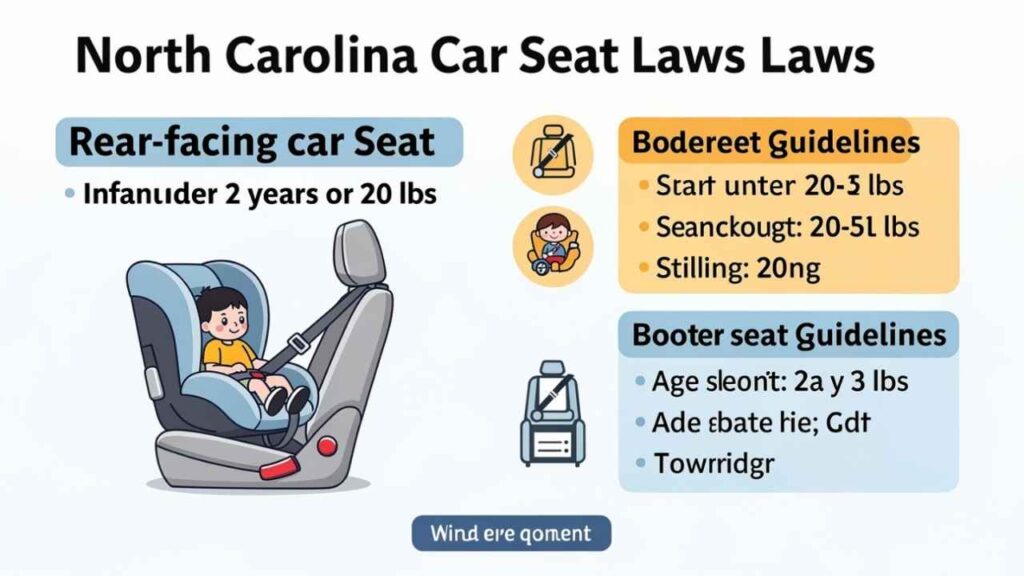
A rear-facing car seat works by spreading the force of a crash across the widest possible surface area of the child’s body. The back of the seat absorbs the energy and moves with the child rather than against them. In a frontal collision, which is the most common type of serious crash, a rear-facing infant essentially rides out the impact in a position that protects their head, neck, and spine simultaneously.
A forward-facing child in the same crash is held back by the harness while their head and torso pitch forward against that restraint. The forces concentrate at specific points rather than distributing broadly. For adults with fully developed cervical vertebrae and strong neck musculature, this is manageable. For an infant whose neck cannot yet reliably support the weight of their own head, it is a completely different story.
The reduction in fatality risk for properly restrained infants compared to unrestrained infants in crashes is not a small percentage point difference. It is the difference between survival and not surviving in many real-world accidents that would otherwise be non-fatal for adults in the same vehicle.
I think about this every time someone tells me their baby hated the rear-facing position and they turned them around early. I understand the instinct. A screaming baby in the car is genuinely stressful and distracting. But the discomfort of rear-facing is almost always solvable through seat angle adjustments, mirror positioning, toys within reach, and music. Early rotation to forward-facing is not the solution the safety data supports.
Penalties Under Current Law
The financial penalty for a child restraint violation in North Carolina is a maximum fine of $25 and two points added to the driver’s license. On paper that sounds almost insignificant, and compared to some other states it is relatively modest.
But two license points are not nothing. North Carolina uses a points system that accumulates across violations, and drivers who hit certain thresholds trigger mandatory insurance surcharges and eventually face suspension proceedings. More practically, a citation involving a child’s safety in your vehicle is the kind of thing that shows up in driving records and can affect insurance premiums at renewal.
None of that is the real reason to comply. The real reason is that the laws exist precisely because the consequences of non-compliance in an actual crash are catastrophic and irreversible. The fine is what happens if an officer pulls you over. The other outcome is what happens if you are in a serious accident with an improperly restrained infant.
Where North Carolina Law Ends and Best Practice Begins
The law sets a legal minimum. That is its job. It tells you what you cannot do without facing a penalty. It does not necessarily tell you the safest possible thing you can do.
The American Academy of Pediatrics has consistently recommended keeping children rear-facing for as long as physically possible based on the seat’s manufacturer limits, regardless of age. A child who just turned two but who still fits comfortably within the rear-facing height and weight limits of their convertible seat is safer rear-facing than forward-facing, full stop. The law does not require you to turn them around at two. Nothing requires you to turn them around at two. You can and should keep them rear-facing as long as the seat allows.
Similarly, the law allows children to move out of booster seats at age eight or 80 pounds under current rules. That does not mean an eight-year-old who is four feet tall and 82 pounds is ready for a seatbelt without a booster. The belt almost certainly does not fit correctly on that child’s body. A booster seat at that point is not overkill. It is the appropriate tool for the job.
Think of the legal standard as the absolute minimum threshold you must clear and then set your own personal standard above it based on your child’s actual size and developmental stage.
The Installation Problem Nobody Talks About Enough
Here is something that does not get enough attention in conversations about car seat laws: the seat itself is only half of the equation. Correct installation is the other half, and most parents get at least part of it wrong on the first attempt.
This is not a judgment. The instructions that come with infant car seats are dense, the diagrams are small, and every vehicle is slightly different. A seat that installs perfectly in one car may need a completely different approach in another vehicle due to seat angle, anchor placement, and belt routing differences.
The things most commonly missed include the seat moving more than one inch in any direction once installed, harness straps routed through the wrong slots for the child’s current shoulder height, chest clips sitting over the belly instead of the chest, and seats installed at too upright an angle for a newborn’s airway. That last one is particularly important. An infant whose head flops forward because the seat angle is too upright can experience airway restriction even without any crash occurring.
The one-inch rule is the starting check: grab the seat at the base near the belt path and push front-to-back and side-to-side. If it moves more than one inch in any direction, it is not tight enough. Most people are surprised by how firm the installation needs to be to pass this check.
Free Car Seat Inspections in North Carolina
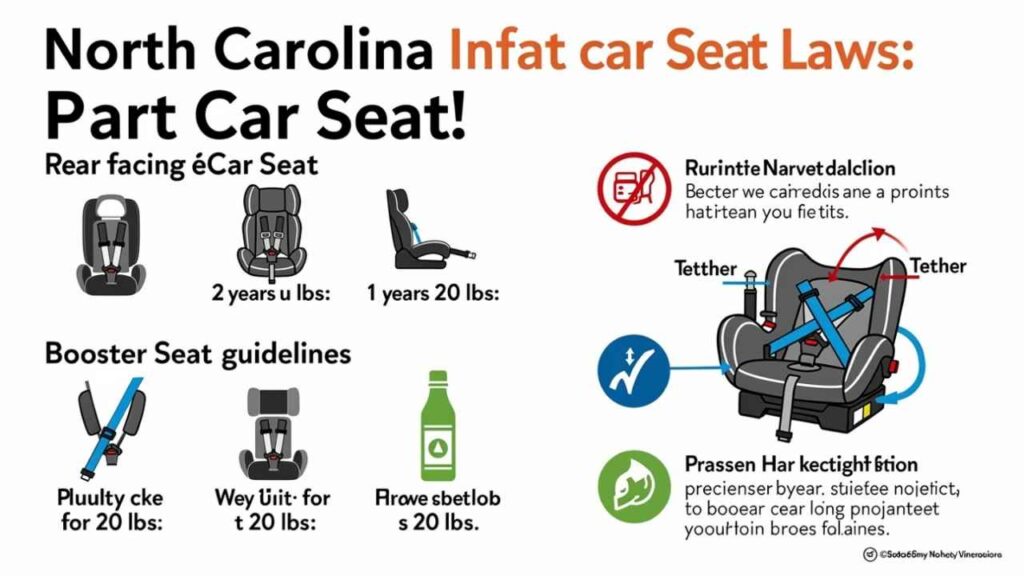
North Carolina has a genuinely good network of free car seat inspection resources, and not enough parents take advantage of them.
Buckle Up NC, run through the University of North Carolina Highway Safety Research Center, is the state’s primary child passenger safety initiative. They maintain updated resources on inspection events and certified technician locations across the state.
Many local fire stations have certified Child Passenger Safety technicians on staff who can inspect your installation at no cost. You often just need to call ahead to confirm availability. WakeMed Health and Hospitals in the Raleigh area runs a dedicated car seat safety program. Safe Kids coalitions operate across multiple NC counties and host regular inspection events.
The Safe Kids Worldwide website has a seat check finder tool where you can enter your zip code and locate the nearest inspection station or event. The inspection itself takes about 30 to 45 minutes, covers both the installation and the child’s positioning in the harness, and is completely free.
After my own experience with the mispositioned chest clip, I made it a personal rule to get every new seat inspected before relying on it for a single significant trip. The peace of mind alone is worth the 45 minutes.
A Few Things Worth Knowing About Seat Selection
North Carolina law requires a weight-appropriate restraint system, which gives parents some flexibility in which type of seat they purchase. But the choices can feel overwhelming in a big-box store with forty different seats on display across three price ranges.
Infant-only seats are designed for newborns through approximately 22 to 35 pounds depending on the model. They come with a base that stays installed in the vehicle and a carrier that clicks in and out, which makes transferring a sleeping baby significantly easier. Their limitation is the lower weight ceiling, which means you will outgrow the seat faster.
Convertible seats start rear-facing and convert to forward-facing as the child grows, offering a much longer window of use from a single purchase. They are larger and less portable but accommodate rear-facing weights up to 40 or 50 pounds in many models, which aligns well with extended rear-facing recommendations.
All-in-one seats take the child from infancy through the booster stage. They are the most economical over time but bulkier and not ideal if you need to transfer the seat between vehicles frequently.
Regardless of which type you choose, confirm that it carries a federal compliance certification. Every car seat sold legally in the United States must meet Federal Motor Vehicle Safety Standard 213, which governs crash performance, harness strength, and labeling. Never purchase a seat from an overseas marketplace that cannot confirm FMVSS 213 compliance.
One more thing worth saying plainly: never use a car seat that has been in a crash, even a minor one, and never use a seat that has passed its expiration date. Expiration dates on car seats exist because the plastic components that bear crash loads degrade over time, particularly when subjected to repeated heating and cooling cycles in a parked vehicle. Most seats expire six to ten years from the manufacture date, which is printed on a label on the seat itself.
👉🏻Discover More About Unique Information[ Graco Car Seat Expiration ]
Frequently Asked Questions
When can a baby face forward in North Carolina?
There is no specific minimum age written into NC law for turning a child forward-facing. The practical weight threshold under current law is 40 pounds. Safety experts recommend staying rear-facing until the seat’s manufacturer limits are reached, which is often well past age two for many children and seat combinations.
Can a rear-facing car seat go in the front seat in NC?
Only under specific exceptions: if the vehicle has no rear seat, if the front passenger airbag can be fully deactivated, or if the car seat is specifically designed and labeled for use with front airbags. In any other situation, rear-facing seats belong in the back seat. A rear-facing seat in front of an active airbag is a serious safety hazard.
What is the actual fine for a car seat violation in North Carolina?
The maximum fine is $25 with two points added to the driver’s license. The driver is held responsible, not the other adult passengers in the vehicle.
What does House Bill 368 change about NC car seat law?
If enacted, H368 replaces the 80-pound weight threshold with a 57-inch height standard, explicitly mandates rear-facing seats for newborns in the statute text, and establishes specific physical criteria for when a child can safely transition to a standard seatbelt without a booster. The projected effective date is December 1, 2025.
How do I know if my car seat is installed correctly?
The seat should not move more than one inch in any direction when pushed firmly at the belt path. Harness straps should come from at or below the infant’s shoulders in rear-facing mode. The chest clip goes at armpit level. The seat angle should match the manufacturer’s recommended recline for the child’s age. When in doubt, visit a free car seat inspection station.
Does NC car seat law apply to taxis and rideshare vehicles?
Yes. NC law applies to all motor vehicles operated on public roads. If you are traveling with an infant in any vehicle, a proper car seat is required. Parents using rideshare services are responsible for bringing and correctly installing their own seat.
My toddler hates rear-facing. Can I turn them around early?
Legally, once they exceed 40 pounds under current law, you have more flexibility. From a safety standpoint, rear-facing discomfort is almost always solvable through seat angle adjustments and distraction strategies. Turning a child forward-facing before they outgrow the seat’s rear-facing limits meaningfully increases injury risk in a frontal collision.
Where can I get a free car seat check near me in NC?
Visit the Safe Kids Worldwide website and use their seat check finder with your zip code. You can also contact your local fire station, check the Buckle Up NC website for events, or reach out to WakeMed if you are in the Triangle area.
Conclusion
North Carolina’s infant car seat laws are built around a simple truth that research has confirmed over and over: the rear-facing position is the safest place for a young child in a moving vehicle, and keeping them there for as long as physically possible is the right call regardless of what the legal minimums technically permit. The law sets the floor, the science points higher, and your child’s safety is the only metric that genuinely matters.
If there is one thing to take away from all of this, it is that getting a free car seat inspection is worth every minute of your time. An expert set of eyes on your installation costs you nothing and could change everything in the event of a crash. Drive carefully, install correctly, and do not rush any of the transitions. Your child will be in that back seat for years, and every stage you get right is another layer of protection that was entirely within your control.

Michael is a car seat specialist with 4 years of experience in reviewing, testing, and guiding people on the best car seat choices. He creates clear, reliable content to help users make safe and confident decisions.